Demystifying the ERCP Procedure: Bile Duct Stones and Jaundice
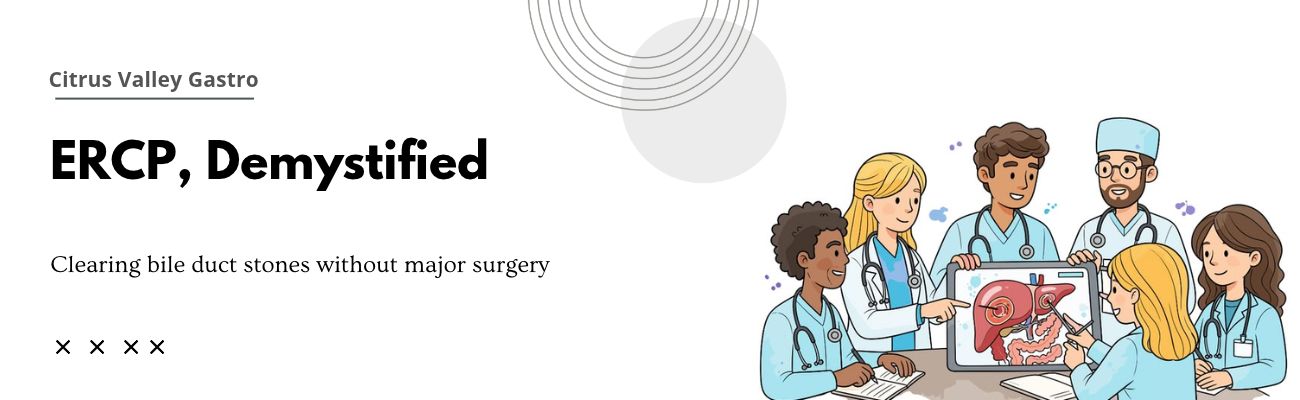
Few medical terms sound as intimidating as ERCP. The name is long, the equipment sounds complex and the idea of a scope working near your liver and pancreas can feel overwhelming. In reality, the ERCP procedure is one of the most valuable tools in digestive medicine. It lets doctors find and fix problems in the bile ducts without a single incision. For people with bile duct stones, or yellow skin and eyes with no clear cause, it can mean relief in one short visit instead of major surgery. At Citrus Valley Gastroenterology, our GI doctors in Covina, Glendora and Chino want you to understand every step, so here is how it works.
What Is ERCP? Understanding Endoscopic Retrograde Cholangiopancreatography
Endoscopic retrograde cholangiopancreatography, or ERCP, combines two techniques: endoscopy and X ray imaging. Your doctor guides a thin, flexible tube with a light and camera through your mouth, past your stomach and into the first part of the small intestine. From there, a tiny catheter reaches the opening where the bile duct and pancreatic duct drain into the intestine. Contrast dye is injected so the ducts show up clearly on live X ray, and tools passed through the scope can treat what is found.
Years ago, ERCP was often used only to look for problems. Today, imaging tests such as ultrasound, CT and MRI usually handle diagnosis, so ERCP is mainly used for treatment. It is the step doctors take when they already suspect something needs to be fixed.
What Causes Bile Duct Stones and Unexplained Jaundice?
Bile is a digestive fluid made by the liver. It travels through small tubes called bile ducts to the intestine, where it helps break down fats. Gallstones that form in the gallbladder can slip into these ducts and block the flow of bile.
When bile cannot drain, a substance called bilirubin builds up in the blood and turns the skin and eyes yellow. This is jaundice. Unexplained jaundice, meaning yellowing without an obvious cause such as hepatitis, always deserves a prompt workup, because it can point to blocked ducts, narrowing, inflammation or tumors.
Warning signs of a blocked bile duct include:
- Yellow skin or eyes
- Pain in the upper right or middle abdomen
- Dark urine and pale or clay colored stools
- Itchy skin
- Nausea, vomiting, fever or chills
Fever with jaundice and abdominal pain can signal a serious infection of the bile ducts. Seek emergency care right away if this happens.
How Is the ERCP Procedure Performed?
ERCP is usually done in an endoscopy suite or hospital, with a team that includes your gastroenterologist, nurses and an anesthesia provider. Here is what typically happens:
- You receive sedation or anesthesia so you stay comfortable and relaxed.
- The doctor passes the scope through your mouth and into the small intestine.
- A small catheter is guided into the bile duct opening, and contrast dye is injected.
- X ray images reveal stones, narrowing or blockages.
- Special tools pass through the scope to treat the problem on the spot.
Most ERCP exams take 30 to 90 minutes. Because nothing is cut through the skin, there are no external incisions.
How Does ERCP Clear Stones From the Bile Duct Without Surgery?
Before ERCP, removing a stone stuck in the bile duct often meant open surgery. Today, the stone can usually be removed through the scope.
Sphincterotomy and Stone Removal
To reach the stone, your doctor may make a tiny cut in the muscle at the duct opening. This step is called a sphincterotomy, and it widens the exit so stones can pass. The doctor then sweeps the duct with a small balloon or basket to pull stones into the intestine, where they pass naturally. Larger stones may be broken into smaller pieces first with a laser or a mechanical device.
Bile Duct Stent Placement for Blockages
When a stone cannot be removed in one session, or the duct is narrowed by scar tissue or a growth, the doctor can use bile duct stent placement. A stent is a thin plastic or metal tube that holds the duct open so bile can drain and jaundice improves. Stents can be temporary or longer lasting. Your doctor can also take tissue samples or brush cells from a narrowed area to find the cause.
ERCP clears the duct, but it does not remove the gallbladder, where the stones usually form. Many patients with gallstones also need to discuss gallbladder removal with a surgeon to keep new stones from returning.
ERCP Preparation: What to Do Before Your Procedure
Good ERCP preparation helps the exam go smoothly. Your gastroenterologist will give you instructions that fit your health, but they usually include:
- Fasting for several hours beforehand, typically after midnight
- Reviewing your medications, especially blood thinners, diabetes medicines and aspirin
- Telling your team about allergies, especially to contrast dye or iodine
- Arranging a ride home, since you cannot drive after sedation
ERCP Recovery Time: What to Expect After Your Procedure
After your ERCP, you will rest in a recovery area for an hour or two while the sedation wears off. Most patients go home the same day, although some stay overnight for observation, especially after a more complex treatment. A sore throat, mild bloating or gas is common for a day. Plan to rest and avoid driving until the next day. Start with light foods and return to your usual diet as you feel ready. ERCP recovery is usually quick, and most people are back to normal routines within a day or two.
ERCP Risks and Complications: How Safe Is the Procedure?
ERCP is safe in experienced hands, but it is more involved than a routine endoscopy, so the risks deserve a clear conversation. The most common complication is pancreatitis, an inflammation of the pancreas that usually settles with rest and fluids. Other possible problems include bleeding after the duct opening is widened, infection of the bile ducts, a small tear in the intestine and reactions to sedation. Your doctor weighs these risks against the danger of leaving a blocked duct untreated, which can lead to serious infection.
Call us or seek care right away if you develop severe abdominal pain, fever or chills, repeated vomiting, black stools or trouble breathing in the days after your procedure.
ERCP vs MRCP: Which Test Is Right for Bile Duct Problems?
MRCP is a magnetic resonance scan that takes detailed pictures of the bile ducts without any scope. It is purely diagnostic, so it is often used first when stones are suspected but not certain. ERCP is chosen when your doctor expects to treat the problem. The decision depends on your symptoms, blood tests and earlier imaging, and your gastroenterologist will recommend the right path.
ERCP in Covina, Glendora and Chino: Expert Care From Our GI Doctors
Since 1985, Citrus Valley Gastroenterology has provided compassionate digestive care. Our board certified gastroenterologists offer advanced procedures including ERCP, colonoscopy and EGD, with offices in Covina, Glendora and Chino. If you have yellow skin or eyes, dark urine or recurring upper abdominal pain, do not wait. Our GI doctors in Covina, Glendora and Chino can evaluate your symptoms, review your imaging and tell you whether ERCP is right for you.
FAQs:
1. What does ERCP stand for?
ERCP stands for endoscopic retrograde cholangiopancreatography. It is a procedure that uses an endoscope and live X ray imaging to diagnose and treat problems in the bile ducts and pancreatic duct.2. What is an ERCP used for?
An ERCP is used to diagnose and treat problems in the bile ducts, gallbladder, liver and pancreas. Doctors most often use it to remove stones from the bile duct, place stents in blocked or narrowed ducts, relieve jaundice, treat bile leaks and collect tissue samples.3. How long does an ERCP procedure take?
It usually takes 30 to 90 minutes, depending on what your doctor needs to treat. Expect to spend two to four hours at the facility including check in, sedation and recovery. Complex cases with multiple stones or stents can take longer.4. Is ERCP a major surgery?
No. ERCP is not a major surgery. It is a minimally invasive endoscopic procedure done through the mouth with sedation, so there are no external incisions. Most patients go home the same day, and recovery is much faster than with open bile duct surgery.5. Is ERCP painful?
No. You are sedated or under anesthesia, so most people feel no pain during ERCP. Afterward, a sore throat, bloating or mild cramping is common for a day. Severe pain, fever or vomiting is not normal and needs prompt medical attention.Published on 27 Oct, 2026
